In high-head hydropower and pumped-storage schemes, penstock steel does far more than resist static pressure. It must survive cyclic loading, water-hammer transients, fatigue, low-temperature service and the full burden of field fabrication. For this reason, grade selection should never be reduced to "the higher the strength, the better." The real engineering question is whether strength, toughness and weldability can be balanced without shifting hidden risks into fabrication, inspection or long-term operation.
Strength: thinner plates, tighter constraints
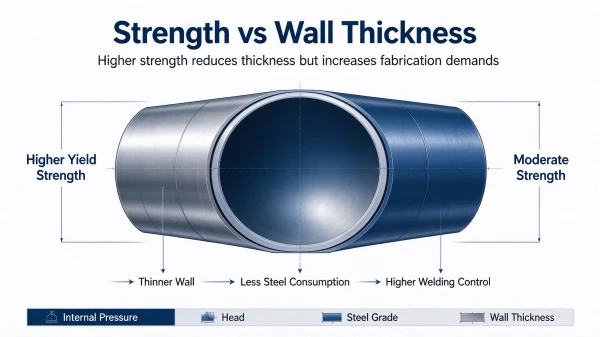
Higher yield strength clearly benefits penstock design. Under the same internal pressure, a higher grade allows reduced wall thickness, lower steel consumption, lighter handling and shorter rolling and erection cycles. The advantage is most pronounced in large-diameter high-head lines, steep sections and bifurcation zones.
But strength rarely comes free. As yield strength increases, carbon equivalent and cold-crack sensitivity typically rise, and the material becomes more sensitive to welding thermal cycles. Ultra-high-strength grades can save weight, yet they often impose stricter requirements on welding procedure, preheat control, heat input, inspection and post-weld treatment. If these constraints are underestimated, the apparent material saving can be offset by fabrication difficulty.
Toughness: the barrier against brittle failure
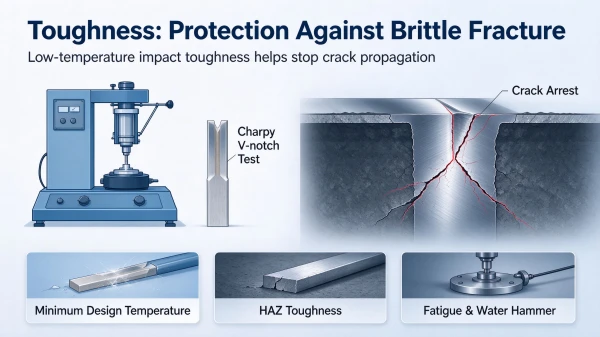
Toughness governs whether a defect remains local or develops into a running crack. It is normally assessed through Charpy V-notch impact testing at the minimum design temperature, with particular attention to the weld metal and heat-affected zone.
Penstocks are not static pressure vessels. They experience start-stop cycling, transient pressure surges and local stress concentrations at supports, stiffeners, openings and branch connections. In cold or high-altitude environments, low-temperature toughness becomes a hard design constraint rather than an optional margin. A plate that satisfies yield strength on the mill certificate may still be unsuitable if its HAZ toughness cannot tolerate realistic fabrication defects or service transients.
Weldability: where theory meets the workshop
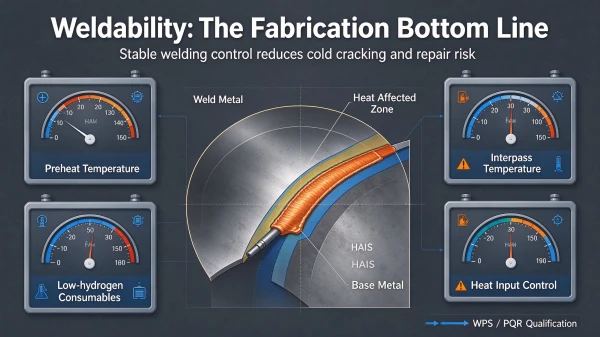
Weldability is often the practical gatekeeper for penstock steel. A grade may look attractive on paper, but if it cannot be welded reliably under site conditions, it is not a viable choice.
High carbon equivalent steels typically require low-hydrogen consumables, controlled preheat, limited interpass temperature, restricted heat input and, in some cases, post-weld heat treatment. They also demand mature welding procedure specifications, qualified welders and consistent quality control. Where local fabricators lack the necessary equipment or experience, qualification failures, rework and schedule delays can quickly erase any benefit from thinner plates.
By contrast, moderate-strength grades usually offer a wider welding window, lower repair rates and more predictable execution. They may increase plate thickness and weight, but they often deliver a more stable total project outcome.
Choosing the right balance for a specific project
There is no single "best" penstock steel. The appropriate grade depends on the interaction between design conditions and execution capability.
Design head and temperature. High-head, cold-region or frequently cycled systems should retain adequate toughness margin, even if that means accepting a moderate strength grade.
Fabricator capability. The selected grade must match the workshop's welding equipment, heat-treatment capacity, inspection practice and experience with similar steels.
Lifecycle cost, not just plate cost. Savings from reduced thickness should be weighed against welding complexity, inspection workload, schedule risk and long-term integrity.
Critical geometry. At bifurcations, transitions and high-stress zones, crack-arrest behaviour and HAZ toughness often matter more than maximum yield strength.
For most modern penstock projects, the preferred solution is not the highest available strength, but the most compatible combination of strength, low-temperature toughness and site-ready weldability.
If you need support on grade selection, carbon equivalent control, impact toughness requirements or welding procedure development for penstock steel, our engineering team can assist. We supply high-quality steel pipes and plates tailored to project-specific design and fabrication conditions, and we look forward to supporting your next enquiry.