


What quality inspections are required for steel pipes?
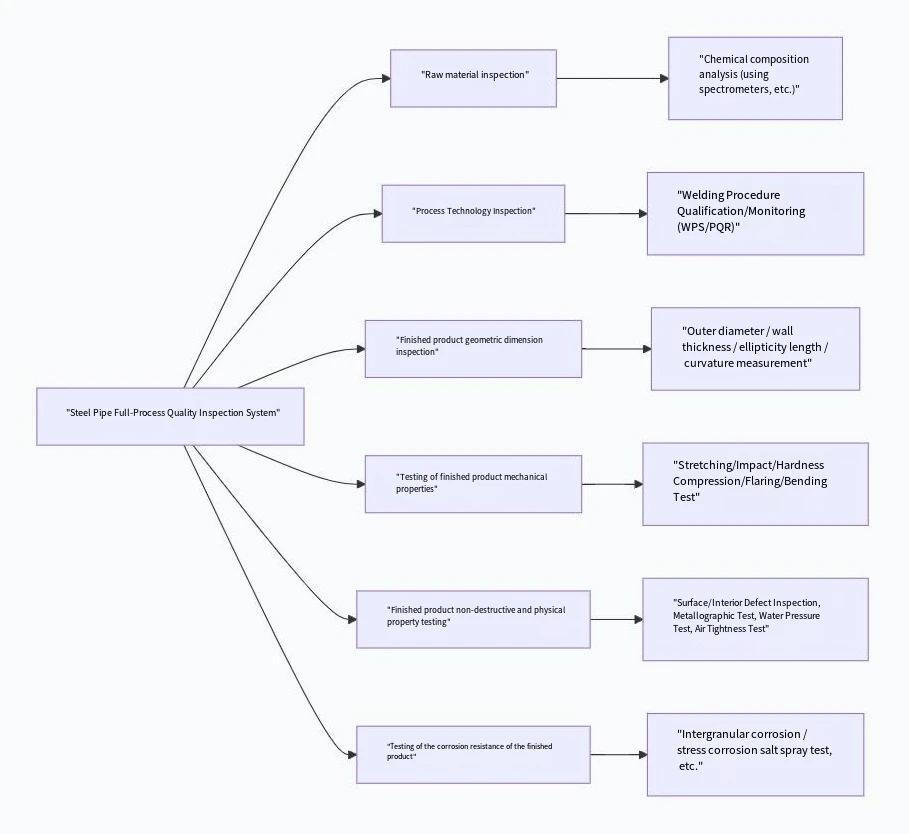
The quality inspection of steel pipes is a full process, multi-level system that runs through the raw materials, production process, and final products to ensure that they meet design standards and are safe to use. The selection of testing items and methods depends on the purpose, standards, materials, and manufacturing processes of the steel pipe.
Overview of the Whole Process Inspection System
Key testing points classified by the purpose of steel pipes
|
steel pipe type |
Typical standards |
Core testing focus |
|
General fluid/structural tube |
ASTM A53, GB/T 8163 |
Chemical composition, mechanical properties (tensile), hydrostatic testing, dimensional inspection. |
|
high-pressure boiler tube |
ASTM A213, GB 5310 |
Extremely strict: chemical composition, high-temperature tensile testing, impact testing, metallographic structure and grain size, 100% non-destructive testing (UT), hydrostatic testing. |
|
Oil and gas pipeline |
API 5L, GB/T 9711 |
High toughness requirements under high strength (strict impact testing), hardness control (HIC/SSC prevention), strict geometric dimensions (conducive to welding), and 100% UT/eddy current testing. |
|
Low temperature pipe |
ASTM A333, GB/T 18984 |
Low temperature impact testing is the core to ensure toughness at the lowest design temperature. |
|
stainless steel pipe |
ASTM A312, GB/T 14976 |
Chemical composition (Ni, Cr, Mo content), intergranular corrosion test, surface quality (smoothness, passivation), non-destructive testing. |
|
welded steel pipe |
ASTM A53, API 5L |
Weld quality is the core: 100% radiographic or ultrasonic testing of welds, mechanical performance testing of welds, and flattening/bending tests. |
Summary
The quality inspection of steel pipes is a comprehensive verification process from the inside out, from static to dynamic, from room temperature to extreme environments.
Fundamentals
Chemical composition+mechanical properties.
Guarantee
Geometric dimensions+non-destructive testing.
Verification
Water pressure/air tightness test.
Deepening
Special tests for special environments (such as low-temperature impact, corrosion, etc.).
When choosing steel pipes, it is not only necessary to know their standards and grades, but also to clarify their necessary inspection items and qualification standards, which is the bottom line to ensure engineering safety and service life.

We are able to provide high quality steel pipes and steel pipe fittings according to customers' needs and look forward to your purchase.


