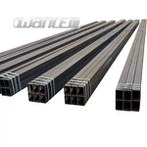
API 5CT casing and tubing are well tubing materials manufactured in accordance with technical specifications established by the American Petroleum Institute (API), primarily used in oil and gas extraction and transportation.
Casing Characteristics
Casing, as a drilling wellbore support material, must meet the strict requirements of API 5CT standards for steel grades, mechanical properties, and dimensions. Common steel grades include J55, N80, P110, etc.
Oil pipe characteristics
Oil pipes are used to transport crude oil from underground to the surface and must withstand higher pressures and corrosive environments. Therefore, stricter requirements are imposed on steel grades (such as H40 and J55) and mechanical properties.
Grade Differences
API 5CT classifies products into three grades: PSL-1 (basic), PSL-2 (increased impact toughness testing), and PSL-3 (severe conditions). Casing is permitted to be manufactured using welding processes, while tubing must undergo quality control procedures such as hydrostatic pressure testing, non-destructive testing, and Charpy impact testing.
Application Scenario
Casing is connected to the wellbore wall via couplings, while tubing directly bears the pressure of high-pressure fluid transportation. There are differences between the two in terms of welding processes, dimensional tolerances, and surface treatment standards. For example, tubing must be accompanied by full-size test reports and traceability markings.