Distinguish flange types by connection method
As one of the most important connecting components in pipeline systems, flanges come in a wide variety of types. It can usually be classified from the perspectives of connection method with the pipe, sealing surface form, and pressure rating.
Classified by connection method
|
type |
schematic diagram |
Features and Uses |
|
Slip-on Flange |
|
Insert the pipeline into the inner hole of the flange and perform fillet welding on the outer side. Easy to install, low cost, but relatively low strength. Suitable for medium and low pressure, room temperature pipeline systems (such as ≤ 4.0MPa). |
|
Welding flange |
|
The flange has a conical neck and is butt welded to the pipeline with a groove. High strength, good fatigue resistance, and uniform stress distribution. Suitable for high temperature, high pressure, and harsh working conditions (such as petroleum, chemical, and power stations). |
|
Socket Weld Flange |
|
After inserting the pipeline into the flange socket, perform fillet welding. The installation has good neutrality and is suitable for small-diameter (DN ≤ 50) and high-pressure pipelines, but its fatigue resistance is not as good as that of welded flanges. |
|
threaded flange |
|
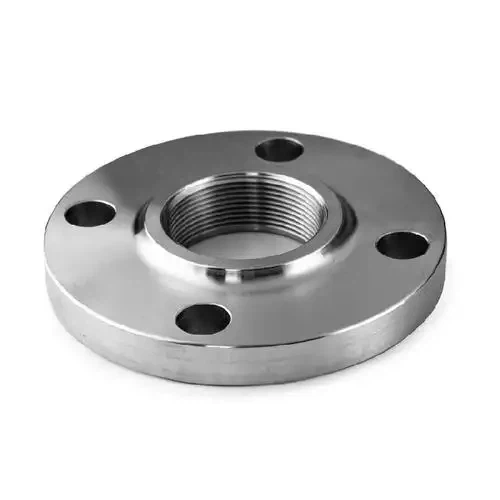
The flange inner hole is machined with threads and screwed into pipes with external threads. No welding required, easy to install and disassemble, but with poor sealing performance, suitable for low pressure, small diameter, and non welding environments (such as galvanized pipes, flammable and explosive areas). |
|
Loose flange |
|
It consists of two parts: a loose flange and a short pipe (flanged joint). The flange can rotate freely on the short pipe for easy alignment of bolt holes. Suitable for expensive pipeline materials such as stainless steel and non-ferrous metals, it can save flange costs. |
| blind flange |
|
One of its functions is to block the end of the pipeline, and the other is to facilitate the removal of debris from the pipeline during maintenance. In terms of sealing effect, it has the same function as the head and pipe cap. But the head cannot be disassembled, and the flange blind plate is fixed with bolts, which is very convenient for disassembly. The materials of flange blind plates include carbon steel, alloy steel, stainless steel, plastic, and so on. |




Summary
A flange is the "building block connector" in a pipeline system, which tightly, firmly, and detachably connects two pipelines or equipment together through bolts and gaskets.

We are able to provide high quality flange according to customers' needs and look forward to your purchase.